CFP: “The Ethics of Animal experimentation”

Call for Book Chapter Contributions

The Ethics of Animal experimentation: Working towards a paradigm change

Editors: Kathrin Herrmann and Kimberley Jayne

Deadline for abstract: January 31st 2016

Even though nonhuman animals are used for a variety of different purposes, their use in research particularly has remained an ethical challenge. It is evident that nonhuman animals in laboratories are exposed to a great deal of physical and psychological suffering, and that the use of animals in research is growing internationally.

Arguably, legal reforms around the world have insufficiently improved the protection of nonhuman animals. However, Directive 2010/63/EU on the protection of animals used for scientific purposes in the European Union is radical compared to other legislation. The Directive promotes a change of paradigm in nonhuman animal experimentation in establishing a goal of the full replacement of the use of live animals in research and education as soon as it is scientifically feasible (Recital 10).

Building on the radical vision of Directive 2010/63/EU, this book aims to illustrate the current situation for nonhuman animals used in science and aims to give a future outlook to the end of their use in research. Besides exploring the current ethical challenges and scientific controversies related to animal experimentation, this Volume aims to discuss ways to work towards a fundamental change of paradigm. We invite contributions from interdisciplinary scholars who share a vision for how this abolition of animal research can be achieved. The goal is to find solutions for this urging problem that are led by a culture of compassion for all animals.

List of recommended topics (but not limited to): Continue Reading

“An Insufferable Business: Ethics, Nonhuman Animals and Biomedical Experiments”

Image taken from Lomir Biomedical's catalogue.

Image taken from Lomir Biomedical’s catalogue, supplier of a range of equipment for animal experimentation.

Why do researchers and biomedical labs continue to use ‘animal models’ in the search for knowledge about human disease despite ethical concerns and widely-reported scientific shortcomings of much of this research? Why aren’t more researchers switching to the newer approaches and technologies which show promise (e.g. human tissue engineering, computer modelling, big data epidemiology, etc.)?

Part of the answer concerns vested economic and career interests. Individual labs and researchers have been established and trained for research using animals. That’s the science they know, and they can’t easily switch over to entirely new technologies. For them, humane alternatives present an obstacle and a threat to their careers and expertise.

But it’s not just researchers who have vested interests in continuing to experiment on animals. In “An Insufferable Business: Ethics, Nonhuman Animals and Biomedical Experiments” (pdf), sociologist Kay Peggs describes the many businesses involved in the billion dollar animal experimentation industry:

“Research establishments, scientists, regulators and persons that inspect laboratories for compliance, those associated with granting licences, companies that sell nonhuman animal subjects and that supply equipment for the research and corporations that market the resulting products are among those that benefit financially.”

As Peggs notes, companies specialize in making customized animals (like OncoMouse™), as well as all of the equipment needed to breed, transport, warehouse, feed and restrain animals at universities and other research locations. They make an array of specialized equipment from guillotines for be-heading mice and rats to “undershirts” for holding electrodes, connectors and other equipment in contact with a dog’s skin. All of these businesses stand to lose if animal experimentation is phased out in favour of ethically and scientifically superior alternatives. These businesses aren’t driven by the search for knowledge, let alone ethical considerations. Their only focus is on the bottom line — protecting the status quo and its lucrative markets for their products and services.

Upcoming Talk: “Beating Hearts: Abortion and Animal Rights”

Colb and Dorf

When: Tuesday, October 13th from 3:30 pm to 5:30 pm
Where: Watson Hall, room 517  (please note room change from previous announcements)

Professors Sherry Colb and Michael Dorf from the Cornell Law School will discuss the ways that pro-life arguments are invoked by both opponents of abortion and proponents of animal rights, and the political and philosophical challenges involved in linking or separating the two cases. Their presentation will draw upon their forthcoming book Beating Hearts: Abortion and Animal Rights (Columbia University Press, 2016). Colb and Dorf are well-known commentators on a variety of constitutional law issues, including animal law cases. Some of Sherry’s more popular animal-related writings are collected in her Mind If I Order the Cheeseburger? And Other Questions People Ask Vegans (Lantern 2013).

This event is part of the new Colloquium in Legal and Political Philosophy, an initiative of the Faculty of Law, the Department of Philosophy, and the Department of Political Studies. All are welcome.

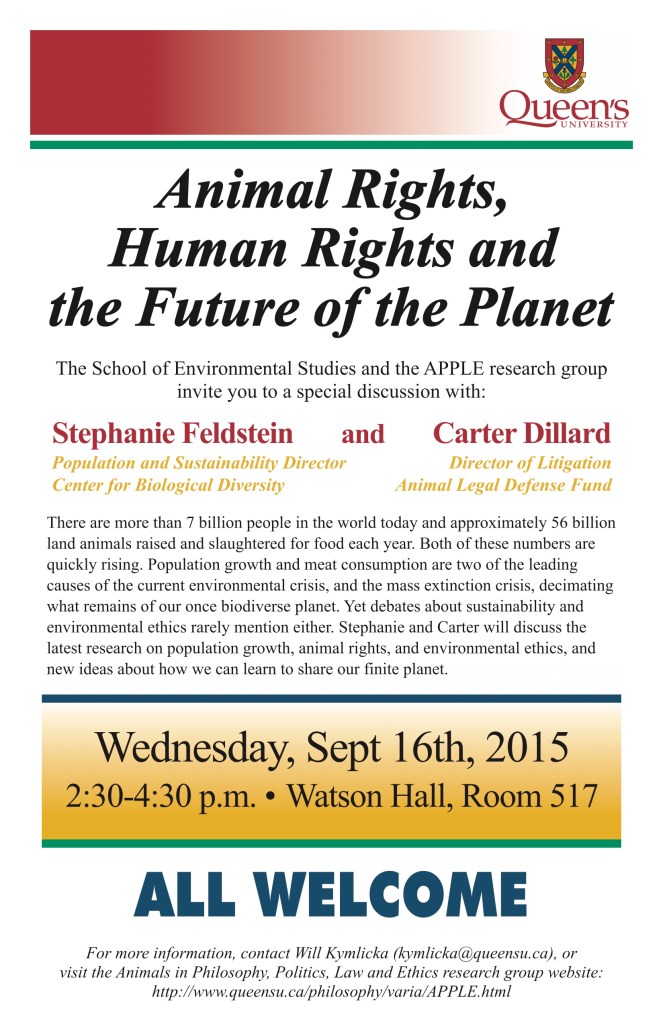
Upcoming Talk: “Animal Rights, Human Rights, and the Future of the Planet”

WednesdaySept16posterFINAL

A new school year is just beginning and we already have an event on the campus!

The School of Environmental Studies and APPLE research group invite you to the talk “Animal Rights, Human Rights, and the Future of the Planet” that will be given by Carter Dillard and Stephanie Feldstein.

  • Wednesday Sept. 16th, 2:30pm to 4:30pm
  • Watson Hall, Room 517

Abstract:

There are more than 7 billion people in the world today and approximately 56 billion land animals raised and slaughtered for food each year. Both of those numbers are quickly rising. Population growth and meat consumption are some of the leading causes of the current mass extinction crisis, putting humans on the path to replacing other species with ourselves and the domesticated animals we eat, decimating what remains of our once biodiverse planet. And yet, environmentalists rarely mention either. Livestock are often bred in cruel factory farms, occupy more than 25 percent of the earth, use one-third of arable land for their feed, and are responsible for massive amounts of water use and greenhouse gas emissions, making meat production and consumption one of the most inhumane and devastating industries on the planet – not only for farm animals, but for the wildlife and environment they impact. As world population and globalization continue to grow, so will the demand for animal products.

Meanwhile, due in large part to our explosive growth and voracious appetites, wildlife species are going extinct at the fastest rate since the time of the dinosaurs and climate change is threatening life on this earth as we know it. Yet the topics of population growth and overconsumption – particularly of animal products – is usually left out of conversations in law schools and the legal academy and among environmental groups, activists, and the media. All of this raises crucial questions that are rarely asked: Why are we, and the animals we eat, replacing other species on earth? Is the animal rights movement really progressing given the ongoing mass extinction of other species? Has the environmental movement failed given the prospects for extinction, anthropogenic climate change, and other environmental crises? How do human rights play into these issues, if at all? Can we rethink our most basic moral and legal norms to prevent the degradation of our world? Why aren’t more people talking about population growth and animal agriculture, and can we really do anything about it?

The speakers will discuss the vital connections between animal agriculture, human population growth, environmental protection, and systems of rights – both human and animal. They will explain how to use this synergy – along with advocacy, creativity, and legal action – to get beyond the stigma and taboo that usually keep population growth and our diets out of conversations and they will suggest legal reforms and practical ways for each of us to create a better future for all species Continue Reading