Three Talks on Animal Ethics at Queen’s

Lynda Birke talk

This month, we are lucky to have three exciting public talks related to animal ethics at Queen’s!

Will Kymlicka: “Rethinking membership and participation in an inclusive democracy: cognitive disability, children, and animals”

Professor Will Kymlicka, Canada Research Chair in Political Philosophy, Department of Philosophy Queen’s University
When: Thursday, March 19th, 4pm (to 6pm)
Where: Watson Hall, Room 517, Queen’s University

Abstract:

In our recent book Zoopolis: A political theory of animal rights, Sue Donaldson and I argued that domesticated animals ought to be recognized as co-citizens of shared political communities with humans. As a result of domestication, we have incorporated them into our society, and we therefore owe them rights of membership and citizenship, including the right to have a say regarding the future of our shared social world. But what does it mean to enable domesticated animals to have a say? In this paper, we explore this challenge by considering developments regarding the rights of children and the rights of people with cognitive disabilities. Recent UN Declarations state that children (even young children) and people with disabilities (even severe intellectual disabilities) are full members of society, and as such must be given a say in matters that affect them, in ways that are meaningful to them. This has generated some remarkable innovations in both the theory and practice of citizenship, and we will argue that these innovations can inform animal advocacy as well. Indeed, drawing together these diverse struggles for membership and participation can help us imagine what a truly inclusive society and democracy might look like.

Speaker bio (from APPLE’s website): [Kymlicka’s] current research focuses on “The Frontiers of Citizneship”, and in particular on struggles to extend norms and practices of citizenship to historically excluded groups, ranging from children and people with intellectual disabilities to indigenous peoples and animals. All of these cases challenge inherited ideas of what defines the attributes of a (good) citizen, and in much of the popular debate and academic literature, attempts to extend citizenship to these groups is often seen as somehow diluting the fundamental values of citizenship. His work disputes this view, and seeks to show how these struggles for inclusion deepen citizenship in Canada and elsewhere. His paper on “Animals and The Frontiers of Citizenship” (co-authored with Sue Donaldson) was presented as the 2013 HLA Hart Memorial Lecture at Oxford University, and will be published in the Oxford Journal of Legal Studies.

Hayden Lorimer: “Gates of heaven: last landscapes for the companion animal

Professor Hayden Lorimer, Chair of Cultural Geography in the School of Geographical and Earth Sciences, University of Glasgow
When: Friday, March 20th, 3:30 p.m (bar service from 3 p.m.)
Where: George Teves Room, Queen’s University Club

Lynda Birke: “The Place of Animals in Science: Hidden in Plain Sight”

Professor Lynda Birke, Department of Biological Sciences, University of Chester (UK)
When: Monday, March 23rd, from 4pm to 6pm
Where: Robert Sutherland Hall, Room 202 (138 Union Street)
Co-sponsored by APPLE and the Department of Gender Studies.

Speaker bio: Birke is a pioneer in both feminist science studies, and human-animal studies. She is associate editor of the journals Society and Animals, and Humanimalia: A Journal of Human/Animal Interface Studies. She has written extensively on non-human animal experimentation, and her recent work focuses on human-equine relationships. Birke’s many books include: Feminism, Animals and Science: The Naming of the Shrew (1994); Reinventing Biology: Respect for Life and the Creation of Knowledge (with Ruth Hubbard, 1995); and The Sacrifice: How Scientific Experiments Transform Animals and People (with Arnold Arluke and Mike Michael, 2007).

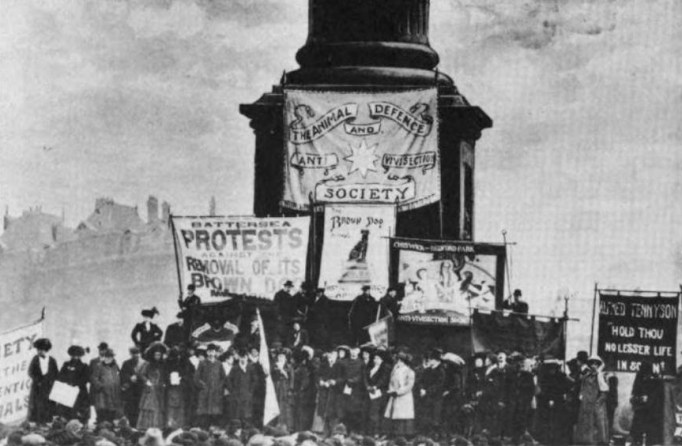
The History of the Anti-Vivisection Movement

Wikimedia Commons

© Wikimedia Commons

Excerpt from Margo DeMello’s Animals and Society: An Introduction to Human-Animal Studies (2012, Columbia University Press), p. 183-185:

The History of the Anti-Vivisection Movement

    Although many people think of the animal rights movement as being very modern, it actually originated in nineteenth-century England, with groups who were opposed to vivisection. The anti-vivisection movement was made up of feminists who were involved in the suffragist movement in England (and later the United States), religious leaders who were opposed to vivisection on moral grounds, and humanists who saw vivisection as a crime against God’s creatures.
    Of all the religious groups voicing their opposition to animal experimentation, the Society of Friends (or Quakers) were the most vociferous. Quakers were unusual among Christian groups in that they believed in an afterlife and a present day when humans and other species could live together in peace. Furthermore, they believed that women and men were spiritually equal; in fact, women were able to preach alongside men. Quakers such as Anna Sewell denounced the cruelty inherent in vivisection. In 1877, Sewell wrote Black Beauty, a story about a horse that experiences a great deal of cruelty in his life. Black Beauty, considered by some to be the Uncle Tom’s Cabin of the animal protection movement, was extremely influential in the growing anticruelty movement in England. And because it was nominally a children’s book, it served to instill in mnay young readers an empathetic understand of animals.
    Suffragists too saw the cruelty of vivisection, and many saw women as being victimized by men in the same ways that animals were by humans. Neither woman nor animals had rights at that time, and many feminists could not help but see the parallels between the treatment of women, who were in those days strapped down during childbirth and forced to have hysterectomies, and animals. In 1875, the National Anti-Vivisection Society, the world’s first such organization, was founded by a woman, Frances Power Cobbe. In 1898, she founded a second group, the British Union for the Abolition of Vivisection. Because of the activities of Cobbe and other anti-vivisectionnists, England passed the world’s first animal protection law, the Cruelty to Animals Act of 1876, which governed the use of animals in vivisection. The law mandated that experiments involving the infliction of pain only be conducted “when the proposed experiments are absolutely necessary… to save or prolong human life” and that animals must be anesthetized, could only be used in one experiment, and must be killed when the experiment was concluded.
    Working-class men, too, for a time took a stance against vivisection. Because the bodies of poor people and criminals were still being used for dissection, many in the working class feared that they would be next. In 1907, a number of different groups coalesced together in the fight against vivisection in a series of events know today as the Brown Dog Riots. They were inspired by the death of a dog that two female medical students claimed had been experimented on multiple times, contrary to the conditions of the Cruelty to Animals Act. The women later installed a memorial to the dog in a park in Battersea, England (the home of an anti-vivisection hospital), that became the focal point of the battle between pro-vivisectionists—mostly medical students—and anti-vivisections—made up of feminists, trade unionists, and socialists. The labor groups saw the medical establishment, largely made up of wealthy elites, as oppressive and thus aligned themselves with the anti-vivisectionists: Both thought of themselves as underdogs. In her book on the riots, Coral Lansbury wirtes, “The issue of women’s rights and anti-vivisection has blended [in the late nineteenth century] at a level which was beyond conscious awareness, and continually animals were seen as surrogates for women who read their own misery into the vivisector’s victims” (1985:128).*
    The anti-vivisection movement arrived in the United States with the opening of the first animal laboratories in the 1860s and 1870s, and the subsequent formation of the American Anti-Vivisection Society (AVVS) in Philadelphia in 1883. Originally, the AAVS was founded to regulate the use of animals in scientific research, but it eventually adopted its current mission of abolishing such research. Similar to the National Anti-Vivisection Society, the AAVS was begun by women who were also involved in other types of social reform such as the struggles for women’s suffrage, child protection, and temperance. Many of these women had also been active in the antislavery movement in the mid-nineteenth century.

Margo DeMello - Animals and Society


* Lansbury, Coral (1985). The Old Brown Dog: Women, Workers, and Vivisection in Edwardian England. Madison: University of Wisconsin Press.

Mini “Organism in a Chip” is an Award-Winning New Technology

Grimm - Against Animal Testing

According to this press release, “researchers at the Dresden-based institute, working jointly with the Institute for Biotechnology at the Technical University (TU) of Berlin, engineered a new kind of solution that could render the use of animal-based experiments superfluous in medical research: a multi-organ chip that faithfully replicates complex metabolic processes in the human body with startling accuracy.” (our emphasis)

Using the compact multi-organ chip (comparable in size to a one-euro piece), and those of three separate microcircuits, researchers can study the regeneration of certain kidney cells. © Fraunhofer IWS

Using the compact multi-organ chip (comparable in size to a one-euro piece), and those of three separate microcircuits, researchers can study the regeneration of certain kidney cells.
© Fraunhofer IWS

See also the Dodo’s article on this exciting new technology.