“Animal Model Research: The Apples and Oranges Quandary”

7401820390_fa06e3f2e5_z-640x325

Photo by Flickr user Novartis AG

Faunalytics has brought attention to Kenneth Shapiro’s paper “Animal Model Research: The Apples and Oranges Quandary” published in 2004 in ATLA questioning the scientific validity of animal models for biomedical and psychological research.

Based on a host of background research, the author lists three ways that animal models fall short in terms of validity:

1. An animal model is never finally or fully validated.
2. Even an animal model for which some degree of validation has been demonstrated is not necessarily a contribution to understanding or treatment effectiveness.
3. Most animal models in biomedical and psychological research are not validated, even in the limited sense described.

With these three statements in mind, the author remarks that it is vitally important to understand animal models “a) in actual practice; b) as presented in the media and white papers by animal research advocates; and c) as they are supposed to work.” According to the author (and, it should be noted, many anti-vivisection advocates) there is a disconnect among these three.

If the animal models have limited validity, “the animal model is limited to a hypothesis generator. It is a locus of discovery not a locus of justification.”

Given that those hypotheses can be generated through a variety of alternative models (such and computer and mathematical models), and given that using animals implies virtually all the time a violation of their basic rights, there is still less reasons to use them in science.

Read the rest of the summary on Faunalytics and the original paper here.

Nonhuman Rights Project, First Step: Judge Recognizes Two Chimpanzees as Legal Persons

This is a breaking news for the animal rights movement, as the Nonhuman Rights Project issued the following press release this afternoon:

BREAKING NEWS

First Time in World History Judge Recognizes Two Chimpanzees as Legal Persons, Grants them Writ of Habeas Corpus

April 20, 2015 – New York, NY – For the first time in history a judge has granted an order to show cause and writ of habeas corpus on behalf of a nonhuman animal. This afternoon, in a case brought by the Nonhuman Rights Project (NhRP), Manhattan Supreme Court Justice Barbara Jaffe issued an order to show cause and writ of habeas corpus on behalf of two chimpanzees, Hercules and Leo, who are being used for biomedical experimentation at Stony Brook University on Long Island, New York.

Under the law of New York State, only a “legal person” may have an order to show cause and writ of habeas corpus issued in his or her behalf. The Court has therefore implicitly determined that Hercules and Leo are “persons.”

A common law writ of habeas corpus involves a two-step process. First, a Justice issues the order to show cause and a writ of habeas corpus, which the Nonhuman Rights Project then serves on Stony Brook University. The writ requires Stony Brook University, represented by the Attorney General of New York, to appear in court and provide a legally sufficient reason for detaining Hercules and Leo. The Court has scheduled that hearing for May 6, 2015, though it may be moved to a later day in May.
Continue Reading

Panel Discussion: “The Place of Animals in Science”

The Place of Animals in Science poster

The reigning paradigm of science education views animals as objects to be manipulated, analyzed and experimented upon. Evidence suggests that this paradigm alienates some students, and excludes alternative perspectives on human-animal relations. This work- shop will explore these hidden costs of the current paradigm, and will examine options for a more humane and inclusive science education. A hands-on demonstration of hu- mane alternatives such as virtual dissection software will be provided.

When: Wednesday, April 22 2015
Time: 6pm to 8:30pm
Where: Duncan McArthur Hall (Queen’s University), Room A343

Speakers:

  1. Jan Oakley, Faculty of Education and Women Studies, Lakehead University
  2. Teresa Lloro-Bidart, Science Education, California State University at Chico
  3. Olivier Berreville, International Network for Human Education

FOI Day: Media Coverage

Photo by Arwin Chan

Photo by Arwin Chan

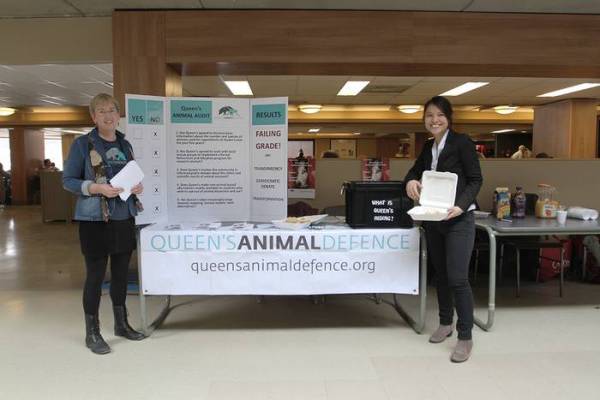
For Freedom of Information Day, not only did we release our latest page regarding What is Queen’s hiding?, but we also tabled and staged an audit on the campus in order to spread the information directly to the community — and to offer free vegan croissants. We were excited to see that, during the following days, our campaign was reported on:

If you have not seen our campaign yet, please take a moment to read What is Queen’s hiding?