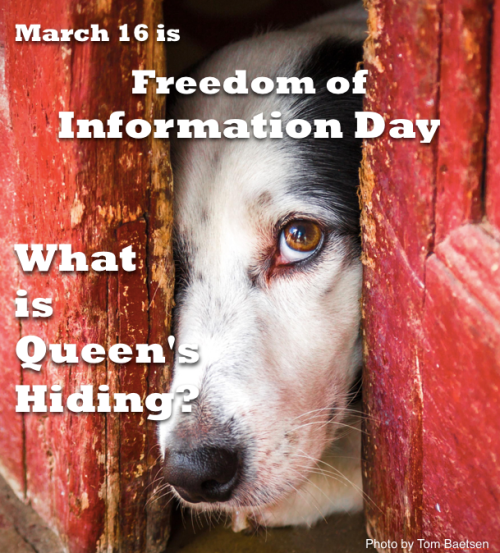
Over two years ago a member of Queen’s Animal Defence (and Queen’s faculty) submitted a freedom of information request concerning nonhuman animals used in research at Queen’s. Queen’s declined to release the information. An appeal was submitted, and we are still awaiting an arbitration decision from the Information and Privacy Commissioner’s Office. (The decision has been delayed three times.)
Queen’s is utterly secretive about research using animals. We don’t know the numbers and types of animals used; the purpose and types of experiments performed on them; the source and ultimate fate of the animals; or the results of any evaluation of the quality or utility of resulting research. In response to requests for information, or justification of research, Queen’s invariably repeats the same mantra: it complies with the guidelines of the Canadian Council on Animal Care (CCAC). The CCAC is a quasi-administrative body governed by animal research interests which establishes guidelines for animal use. The Canadian Federation of Humane Societies is the only advocate for animals on the CCAC – one voice out of 22 member organizations. In other words, the biomedical research industry makes its own rules, behind closed doors. (See this recent post for a more detailed critique of the CCAC.)
We should know by now never to entrust the care of vulnerable beings to powerful organizations acting without public scrutiny. Consider residential schools. Or the sex abuse long tolerated and covered up by the Catholic Church. Or the non-consensual surgeries, experiments and other abuses inflicted on people with disabilities and mental illness in residential institutions. These aren’t cases of a few bad apples run amok – a priest, or government agent or doctor here and there. They are structural, institutional failures on a massive scale – failures that have been deeply exacerbated by misplaced ‘trust’ in experts and authorities.
Queen’s Animal Defence has been criticized for demanding information about what happens to animals at Queen’s – as though it’s bad manners to question the ethics of the research industry, or to suggest that researchers, like all humans, are vulnerable to human frailties like professional myopia, arrogance, careerism and greed. Continue Reading


 Queen's Animal Defence