According to Judges in the US, Apes Don’t Have Rights

collage-copy

Image via nonhumanrights.org

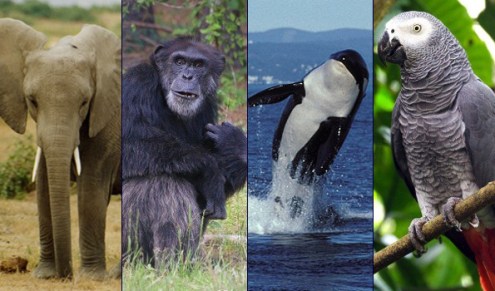
An unfortunate decision following this story in the US ruled that apes don’t have the same rights as humans.

According to “…Justice Karen K. Peters of the Appellate Division of State Supreme Court, writing for the five-judge panel, said that apes’ lackadaisical approach to civic life meant they did not deserve many of the rights afforded most people reading this article…. [the judges found that] ‘Unlike human beings, chimpanzees cannot bear any legal duties, submit to societal responsibilities or be held legally accountable for their actions’… ‘In our view, it is this incapability to bear any legal responsibilities and societal duties that renders it inappropriate to confer upon chimpanzees the legal rights'”

The Nonhuman Rights Project, who originally launched the writ of habeas corpus on behalf of Tommy, a captive chimpanzee, plans to appeal the decision.

Read the full story here
 

More Good News From India

lbSplash

Image taken from leapingbunny.org

Not only has India banned animal experimentation and dissections in universities, but there also a ban on animal testing for cosmetics. Imported cosmetics that test on animals have been banned as well. India has become the first country in south Asia to impose such bans.

Hopefully more countries will follow the lead of Israel, the European Union, and now India in banning animal testing for cosmetics.

Read the story here 

Animal Testing, for the Benefit of Chimps?

Chimpanzee_mom_and_baby_cropped

Image taken from Wikipedia.

In 2013, the National Institute of Health vowed to stop breeding additional chimps for biomedical testing and agreed to re-home all but 50 of their current test subjects. However, some scientists argue for continued testing on chimps, not necessarily for any benefits to human, but for the sake of chimpanzees themselves. For instance, diseases like Ebola affect humans and chimps alike and according to Dr. Peter Walsh, “‘In the last 30 years, [it] has killed about a third of the world’s gorillas, and thousands of chimps, … If we don’t do something about this now, these animals are going to go extinct in the wild.'”

However, others, like Steve Ross argue that “‘If you develop a captive population, test your vaccine and the result is a vaccine that cannot be administered to wild populations and therefore doesn’t save a single chimpanzee, we’ll have done a tremendous disservice to chimpanzees as a whole.'”

Although Dr. Walsh’s proposal is problematic for various reasons, it raises interesting questions about the correct response to declining wild chimpanzee populations. If part of the justification for halting biomedical testing on captive chimpanzees was because they are *”like us”* in some morally relevant way, then is there a duty to find cures for wild apes like we do for humans?

*Note: this is not necessarily meant to support the “they are like us” argument!

Read the full story here.

Computer Software Used to Search for a Cure for Ebola

IBM_Watson

IBM Watson

Researchers at the University of Toronto are using artificial intelligence to help find a cure for Ebola. Using Canada’s largest supercomputer, researchers can analyze all existing and hypothetical treatments for a disease in order to compile data in a matter of days, instead of years. While unfortunately this process doesn’t altogether eliminate use of animal testing (which is required by law), at least it demonstrates meaningful progress in the ‘reduce’ goal of the 3Rs.

As explained in the article, “The testing of pharmaceuticals is normally a physical science – “we still have to build every prototype we test,” said Heifets, resulting in hundreds of thousands of failed experiments for each success. Chematria can do that research virtually, making it 150 times faster than conventional methods, said Heifets. The tech has been applied to malaria, leukemia and Multiple Sclerosis, but in the face of a growing pandemic, creators last week launched an Ebola project.

Read the full article here.